
As the nights draw in by Dammy Ponnuthurai
“Do not store up for yourselves treasures on earth, where moth and rust consume and where thieves break in and steal; but store up for yourselves treasures in heaven, where neither moth nor rust consumes and where thieves do not break in and steal.” Matthew 6:19–21
Unfurling from sleep on a dark December morning, I’m struck by winter’s own sense of minimalism. Maybe the season itself is an analogy which might prompt us to consider what is most important.
As winter deepens, it can feel as though night and day look the same. We know the difference only through our clocks, the glow of a phone screen, the call of morning birdsong. The light at the edges of the curtains is dull and undecided; the world feels as if it has chosen one long, grey middle. Though we mourn the light during the dormancy of winter, there is something new about adapting to the many hours of darkness.
The natural world seems to accept this more easily than we do. Trees, as their leaves disappear, continue to stand with such elegance. Their branches hang with a resilient acceptance of the change; there is no sorrow in their bareness. Gazing at them makes me see them again, as if for the first time. This purposeful gaze, which I’m trying to weave into my days in the spirit of a new year’s resolution, finds me appreciating the wonder of winter in a way I hadn’t before. What looked like loss at first glance begins to feel like clarity.
As the darkness begins earlier on winter nights, we retreat indoors and discover a different kind of serenity. Our living rooms, which had been unused during the summer months, become well loved spaces again. Cushions regain their cosiness, books return to scattered abandon. The English word for this space, “drawing room”, comes from the 16th-century “withdrawing room”. It offers a gentle cue for how we might find a new rhythm in the darker months.
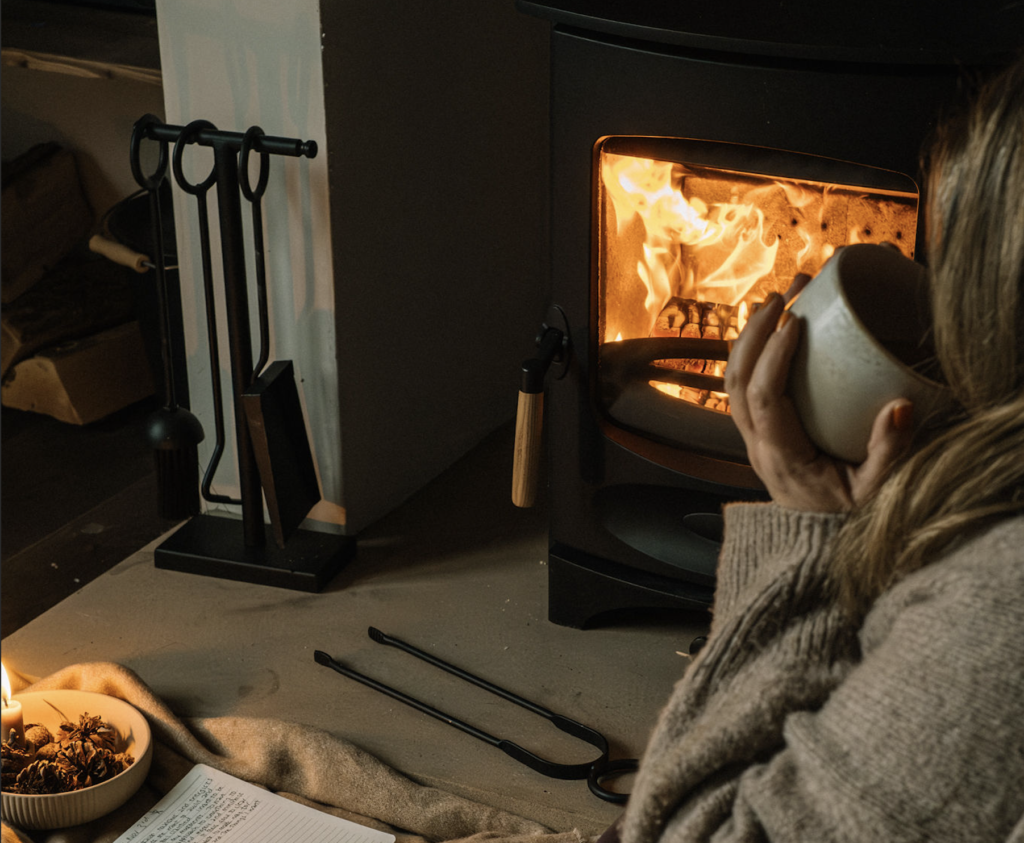
If you are lucky enough to light a fire, with its simple ritual of laying kindling, stacking logs and waiting for flame, you have an irresistible invitation to stay in the cosiness of your living space. For others, there is the way we use light: the flicker of a candle at both ends of a dark day can summon that gathered presence the word drawing room suggests. The music we play or the comfort of radio chatter guides how an evening slowly arranges itself.
Yet, in the desire to appreciate the world of home, I find that venturing outside also matters. One misty, dark-filled Saturday afternoon (it’s only four thirty, but it feels like nine), as I walk to my local shop, I start to think about the word “withdraw”. The silence of the darkness transcends even at this early hour and creates a veil of intimacy over the day.
Withdrawing is often associated with loneliness and stepping back from life, but I wonder if the changing season gives us permission to step away from our own expectations of living life “usefully”. On the winter street, there is a silence not found on summer days. The pressure to elongate our days with constant activity softens. I notice that rather than how often I measure a “good day” by what I have managed to do, instead I now measure it by how attentive I have been too. In a poem about the memory of lost loved ones, Wendell Berry says, “They live now in the permanent world. We are the absent ones.” His line lingers as I pass the rows of houses, each lit from within, each holding lives I will never fully see.
Thinking about absence, I see how much daily life lacks any real liminal space. A to-do list doesn’t give us much opportunity to wonder about our presence in the living world. We move from one small task to the next, carried along by the day’s demands, without quite registering where our attention has gone. The darkness of winter interrupts this flow. Learning to notice small details within the dark offers brief moments of presence. The early darkness confines the patterns of our days, but it can also sharpen our focus on the light that remains. There is a quiet joy in the play of long shadows cast by the winter sun, in a glint on a bare branch, in the flare of flame behind a stove door. These little displays ask almost nothing from us, except that we observe.
It makes me wonder if the absence Berry speaks of comes from our inability to notice the wonder that exists, available in each moment, but which we sometimes fail to see because we are so preoccupied with ourselves. When we allow it, we become fuller inhabitants of the world. These small, easily overlooked moments feel like the kind of treasure that moth and rust cannot touch.
So, in an effort to embrace this dark season, and inspired by Virginia Woolf’s “I am rooted, but I flow”, my intention each day is to really look and see the world around me, so that I don’t lose the detail that is never far from the small gesture of just looking up. To stand, like the winter trees: barer, perhaps, but not bereft. Rooted, still, and yet somehow able to flow.