
Modern stoves and the bigger air quality picture
A recent Guardian article raised concerns about dust on the London Underground, which followed the case of a former worker who warned about possible exposure to asbestos and other hazardous substances while cleaning parts of the network. The article makes uncomfortable reading, not because it means people should stop using the Tube, but because it reminds us that many everyday environments carry risks we do not always see or think about.
That point matters in the wider air quality debate, where pollution is often discussed as though it comes from one obvious source. Real life is more complicated, with airborne particles coming from transport, construction, cooking, candles, cleaning products, barbecues and even natural events such as Saharan dust. Some of these activities are useful or difficult to avoid, which is why the real question is often how they can be made cleaner and safer.
Everyday exposure is more complex than we think
The London Underground is a good example of a useful part of daily life that still needs careful management. The Guardian article reported concerns about toxic dust and asbestos, while COMEAP has previously reviewed the evidence around particulate matter on the Underground. City Hall also notes that Transport for London has a programme to reduce dust and improve air quality across the network. There are also concerns beyond air quality, with London Assembly material referring to independent research showing that passengers can be exposed to Tube noise above 80 dBA, and sometimes much higher.
None of this means London should abandon the Underground, which remains a vital transport system for millions of people. It means the risks should be understood and managed through better monitoring, safer cleaning, improved ventilation where possible and clear protection for workers. Some passengers may also choose to wear a suitable mask on busy or dusty journeys, particularly if they are more vulnerable to air pollution. The sensible answer is not to remove something useful from everyday life, but to improve how it is managed.
The same principle applies in many other places where people may not always think about air quality. Construction dust is a serious occupational risk, with the Health and Safety Executive warning that regular exposure can contribute to lung cancer, asthma, COPD and silicosis. Road traffic remains an important source of nitrogen dioxide and particulate pollution, including particles from brake and tyre wear.
Indoor air deserves attention too, because ordinary household activities can produce particles or affect air quality. NICE guidance notes that indoor particulate matter can be generated by cooking and combustion sources, including candles. Research has also shown that some cleaning product ingredients can react indoors and contribute to secondary pollutants, while studies of common household activities have measured particles from candle burning, cooking and toasting bread. A piece of toast is not a public health crisis, but it is a useful reminder that particle exposure is part of everyday life and needs perspective.
Modern stoves need the same common sense approach
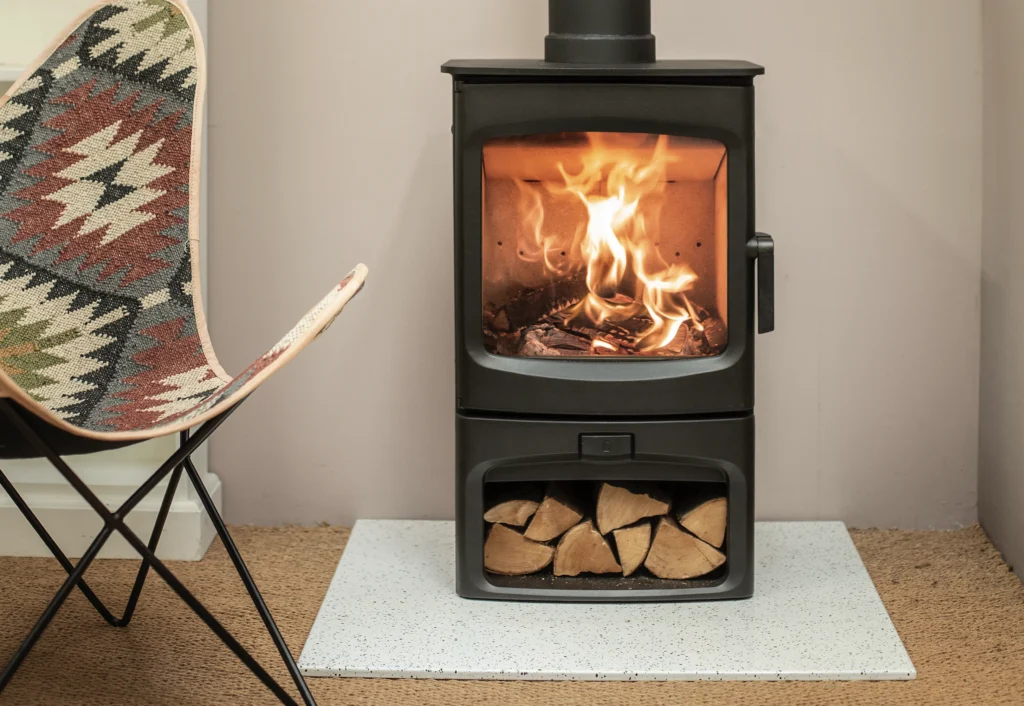
This is where the debate around wood burning needs more balance and better public understanding. A modern wood burning stove is a very useful appliance that provides warmth, comfort and a dependable secondary heat source during power cuts and periods of energy uncertainty. For rural and off grid homes, that resilience is even more important, particularly when other heating systems depend on electricity or wider energy infrastructure.
At the same time, modern wood burning must always be done properly, because the stove, the fuel and the way it is used all matter. An open fire burning wet wood is not the same as a modern Ecodesign stove burning dry, properly seasoned logs. The Stove Industry Association states that UKAS accredited laboratory testing has shown mean particulate emissions from an Ecodesign stove are reduced by up to 90 percent compared with an open fire, and up to 80 percent compared with an older stove.
That difference should help to shape the conversation, because cleaner air is best achieved through practical improvements that target the highest emitting sources. If the answer to Tube dust includes better cleaning and ventilation, and the answer to construction dust is proper controls and protective equipment, then a practical answer to domestic wood burning improvement should also be pursued.
We believe that replacing older appliances and open fires, using dry fuel, maintaining chimneys and stoves properly, following the manufacturer’s instructions and keeping improving combustion technology is the way forward. Done properly, a modern stove can continue to play a valuable role in warmer and more resilient homes.