
Why ‘Just Ban It’ is the wrong answer to complex problems
Modern society has developed a curious habit: when faced with a problem, our first instinct is not to solve it, but to call for its eradication. Campaign groups, pressure organisations and self-appointed moral guardians are often united in their conviction that the easiest way to deal with something they dislike is to ban it outright. But if we applied that logic consistently, the results would be absurd.
Let us begin with an example so commonplace we hardly think about it: the car. Each year cars are responsible for millions of traffic accidents worldwide, with a tragic number ending in fatalities. They pollute the air, clog our cities and contribute to climate change. If the same criteria used to target other technologies were applied here, the case would be clear: cars kill, therefore cars should be banned. Imagine the press release: ‘No more road deaths: ban private vehicles’. It would be a simple solution, except for the small problem that our entire economy, supply chain and personal mobility depend on them. Cars are dangerous, yes, but we regulate them: seat belts, airbags, speed limits, driving tests. We improve them: cleaner engines, electric drivetrains, advanced braking systems. We don’t – because we can’t – ban them.
Now consider the darlings of the green revolution: solar panels, wind turbines and battery storage. The marketing is immaculate – clean, renewable and the embodiment of environmental virtue. But peel back the glossy veneer and some uncomfortable truths emerge. Much of the polysilicon used in solar panels is manufactured in parts of China where forced labour has been credibly reported (1). China’s massive growth in this sector has also come at a huge environmental cost with recent coverage saying the expansion has “caused severe social and environmental damage” in mining regions, underscoring that no technology is impact-free (2).
‘It’s taxpayers’ money and we should not be supporting slave labour with that money… and wherever possible, we should… buy British if we can,’ says Labour MP Sarah Champion (3).
Wind turbines, meanwhile, come with a substantial carbon cost during production and at the end of their life their vast composite blades are notoriously difficult to recycle (4). And batteries, the great hope of our electrified future, have been linked to child labour risks in parts of the cobalt mining sector in the Congo (5). On top of this, extracting rare earths is highly waste intensive with roughly 2,000 tonnes of often-toxic waste produced for every 1 tonne of rare earths. This is a cost which is rarely seen in clean-tech marketing (6).
If we applied the ‘ban it’ principle here, the decision would be easy: slave labour? Ban solar. High carbon footprint? Ban wind turbines. Child exploitation? Ban batteries. And yet, quite rightly, we do not. We recognise that these technologies are vital for a sustainable future. However, it is imperative that those industries rise to the challenge and clean up their supply chains, reduce their impact and improve their recyclability – not to throw them on the scrap heap of history.

50 years of stove development has led to I-Blu combustion technology which is up to 90% more efficient than older stoves and open fires.
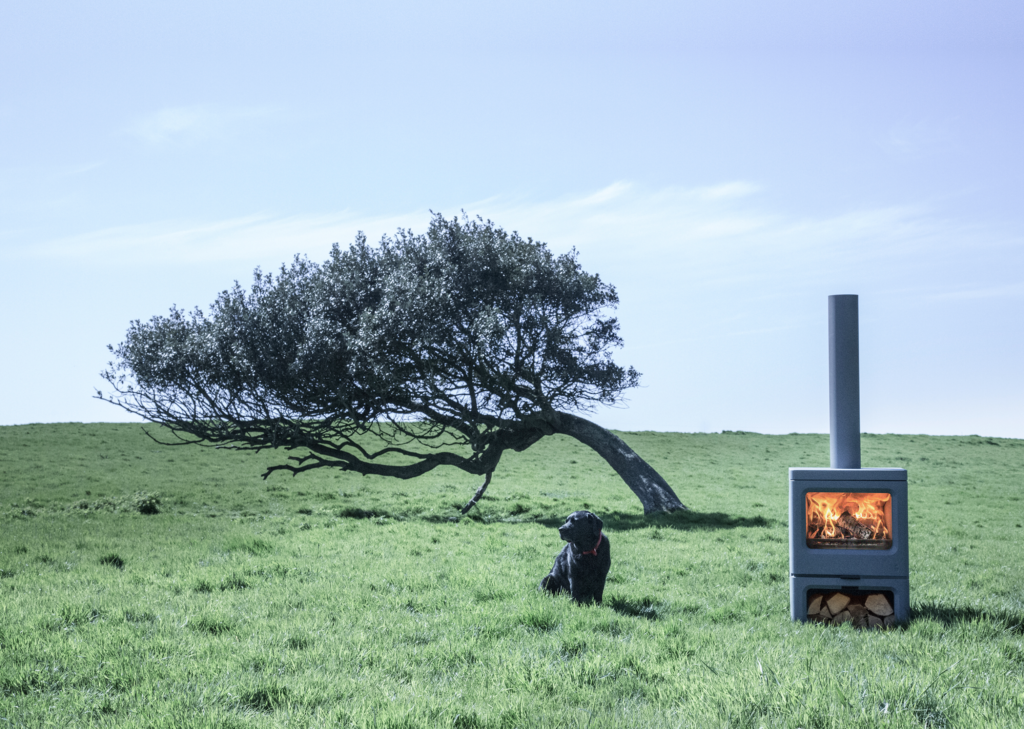
Finally, we turn to a far more ancient technology: wood heating. For thousands of years, humanity has used wood for warmth and cooking. Properly sourced and when burned responsibly, wood is a renewable, local, and carbon-neutral fuel over its lifecycle. Modern wood-burning stoves can be highly efficient, reducing fossil fuel dependence and supporting rural economies. And yet, because of concerns over particulate emissions primarily from older stoves and open fires, some campaign groups have decided the answer is to ban them entirely. No allowance for new designs, cleaner combustion systems, or better user education – just a blanket prohibition. The irony is striking: the same voices willing to overlook the human rights and environmental issues in other energy technologies are suddenly calling for zero tolerance when it comes to wood heat – despite its many sustainable advantages.
Here lies the heart of the problem. Banning is easy. It requires no innovation, no compromise, no messy balancing of trade-offs. But progress comes from tackling problems, not abolishing entire technologies. We did not ban cars to prevent road deaths; we made cars safer. We did not ban solar or wind when confronted with ethical and environmental concerns; we sought to improve them. The same approach should apply to wood heating – or any technology with both benefits and drawbacks.
The path forward is not prohibition but improved regulation and more innovation. It is the hard, patient work of identifying the harms and mitigating them: cleaner fuels, better designs, improved emissions standards, ethical supply chains, better user guidance and effective enforcement where rules exist. ‘Let’s ban it’ may be a catchy rallying cry, but it is rarely a wise policy. If we banned everything with negative side effects, we’d be left with nothing but our faux-moral purity – and a very cold, dark, immobile world.
Further reading:
References:
(1) https://www.bbc.co.uk/news/world-asia-china-57124636
(2) https://www.bbc.co.uk/news/articles/c4gdd6jdm42o
(3) https://www.bbc.co.uk/news/articles/c1lj21pjn72o
(4) https://www.sciencedirect.com/science/article/abs/pii/S0921344924004075
(6) https://www.bbc.co.uk/news/resources/idt-66cdf862-5e96-4e6e-90b8-a407b597c8d9