Wood burning, behaviour change and the need for a balanced debate
As the heating season and Clean Air Night return, many people will see familiar messages about wood burning, particulate emissions and health. Clean air is important to everyone, and modern wood burning is continuing to improve, but there is another part of this debate that needs some attention, which is the way the message itself is actually being shaped.
Fire is also one of humanity’s oldest sources of heat and has played an extraordinary role in our development. For hundreds of thousands of years it has provided warmth, cooked food and created a place for people to gather and build social bonds. That history does not mean wood burning should now be exempt from some scrutiny, but it does raise an interesting question. Why, just as stove technology has become cleaner, more efficient and easier to control, is wood burning increasingly being framed as one of the most antisocial ways to heat a home?
One example is Impact on Urban Health who have worked with behavioural specialists and campaign groups to understand how people feel about wood burning and to seek ways to change those attitudes. Their published work explains that people often associate a real fire with warmth, comfort and a homely atmosphere, while also setting out ways to weaken those positive associations and create a stronger link between wood burning and pollution. Their campaign material describes the use of Google ads to undermine the aspirational status associated with owning a stove, while advertising on Nextdoor sought to disrupt positive associations with cosiness.
There is nothing secret about using behavioural science and it is widely used in public health and government policy. However, when a campaign is not simply about providing information but is actually influencing how people feel about an activity, it becomes even more important that accurate evidence and proper context is provided.
What does it mean to nudge behaviour?
Nudge theory is based on the idea that the way information and choices are presented can influence the decisions people make without the need to remove their choices.
The original Kantar behavioural research commissioned by Impact on Urban Health is open about its objectives as trying to identify opportunities for intervention and to inform a campaign aimed at reducing air pollution from wood burning. However, the same report also acknowledges limits within the evidence base around the health effects of domestic wood burning and that further UK evidence was needed to establish some of the relationships more clearly.
So the question for the wood burning debate is whether people are being given enough balanced information to reach their own conclusions. When campaign material is deliberately designed to weaken associations with warmth and comfort and strengthen associations with pollution and ill health, the line between simply informing people and actively persuading them becomes less clear.
Who gets to join the conversation?
Global Action Plan describes Clean Air Night as an opportunity to spark a national conversation about wood burning and help people make informed choices. We therefore find it disappointing that Charnwood has been blocked from its Instagram account, alongside many other stove industry related accounts.
Of course, organisations are entitled to moderate their own social media channels, however, Clean Air Night has received support from public bodies including the Greater London Authority, Welsh Government and Hertfordshire County Council. When a publicly supported campaign aims to inform choices and encourage discussion, it seems reasonable to ask whether excluding relevant industry voices really helps create the open and balanced conversation that is needed.
Looking beyond the headlines
One regularly repeated claim is that homes using wood burning stoves have around three times as much indoor particulate pollution. The study behind the claim involved twenty households and recorded 260 periods of stove use. It found that average indoor PM2.5 concentrations were higher during days when the stoves were used, while significant peaks were also recorded during normal operation.
Those findings should not be dismissed, because they do reinforce the importance of good operation and careful refuelling. What it does not tell us is whether the same effect occurs to the same extent with the latest Ecodesign appliances, or whether better appliance design and operating practices can reduce that exposure.
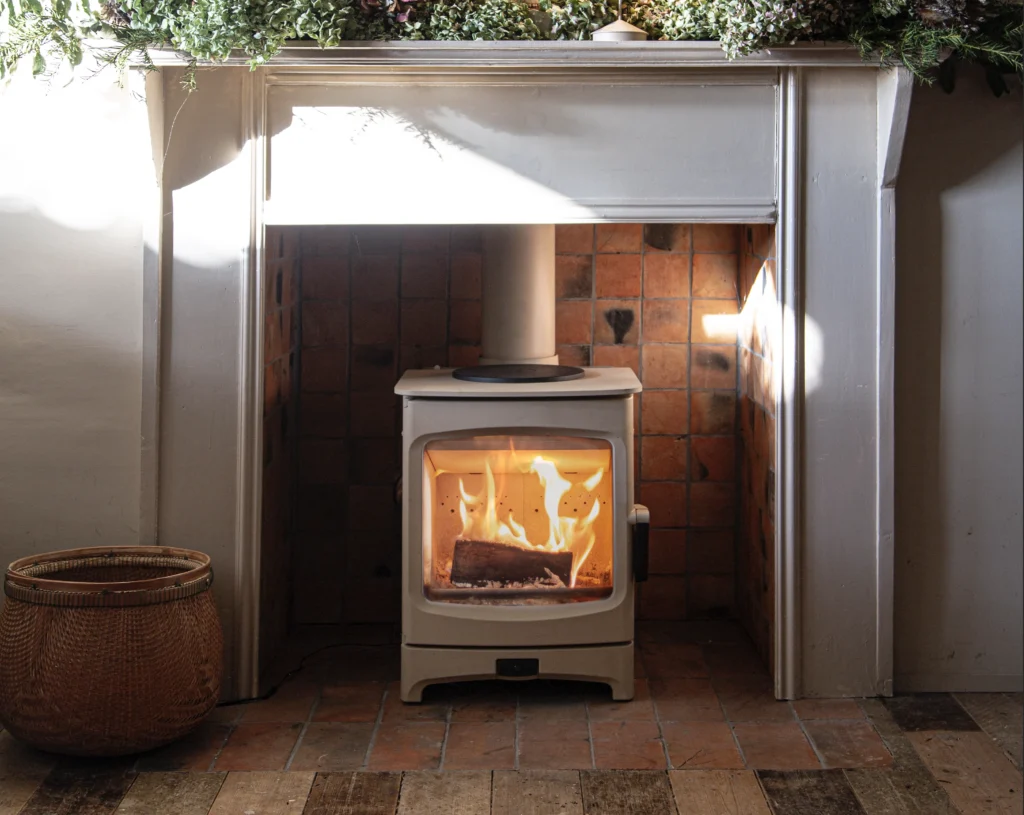
There is also evidence showing why modern stoves should not automatically be treated as though they all perform in the same way. The London Wood Burning Project tested several appliances in real homes, including a Charnwood C Five clearSkies Level 5 stove. Once that stove was lit, adding fuel did not increase indoor PM2.5, and on some occasions concentrations actually fell. The researchers also found that the largest increases in indoor PM2.5 during the monitoring came from cooking, particularly frying, grilling and oven use.
Another widely reported figure suggests that domestic burning contributes to almost 2,500 deaths each year in the UK. However, the report behind that figure is based on modelling rather than 2,500 individually confirmed deaths, and again it covers wood and solid fuel burning generally rather than separating modern Ecodesign stoves from other forms of burning.
The report also models what could happen if all secondary burning stopped. To do this, it assumes that 75% of rural wood and solid fuel burning and 90% of urban burning is secondary rather than a primary heat source. Those are modelling assumptions rather than measured proportions, and they have a significant effect on the scale of the predicted emissions and health benefits. Those assumptions should be clear when headline figures are presented and an estimate should be described as an estimate, rather than sounding like a count of confirmed cases.
When campaigning gets ahead of the evidence
Brighton and Hove City Council ran a campaign describing wood burners and open fires as the “cosy killer”, alongside a claim that particle pollution around four schools was much higher during colder months.
In June 2026, the Advertising Standards Authority upheld complaints about the advertisement because it considered that the presentation implied wood burners and open fires were responsible for the reported increase in particle pollution without sufficient evidence to support that claim.
The ruling does not dispute that wood burning contributes to some extent to particulate emissions. However, it does illustrate a very important point, which is that the conclusion presented to the public should match the evidence and not exagerate things.
The latest data deserve attention too
There is another part of the story that receives considerably less attention in negative headlines. The latest UK Government particulate emissions data shows that total PM2.5 and PM10 emissions from domestic combustion fell by 26% between 2018 and 2024, including a further 7% reduction between 2023 and 2024.
Domestic combustion includes wood, coal and other solid fuels, so these figures cannot tell us exactly how much of the fall in emissions is due to modern stoves alone. But equally, broad figures should not be used in the opposite direction as though they describe emissions from every modern stove. However, the National Atmospheric Emissions Inventory does clearly identify the introduction and increasing uptake of Ecodesign compliant appliances as one of the factors contributing to decreasing emissions from domestic combustion. This is important to keep in mind because, while the public narrative around wood burning has become increasingly negative, appliance standards, fuel regulation and combustion technology have developed and continue to do so.
A fair debate that wants real sustainable progress should acknowledge this positive direction of travel. While further improvements rightly continue to be sought, we mustn’t forget that the technology at the centre of the debate today is not the same technology that was being sold several decades ago.
Behaviour change can also mean better burning
There is a flip side here where behavioural science could actually be used to help people use stoves more responsibly. A randomised study in Chile found that giving stove users clearer information about the pollution linked to different settings reduced use of the most polluting option, with researchers estimating a 10.8% fall in residential PM2.5 emissions.
While the appliances and circumstances were very different from those in Britain, the wider point still remains. Better information can change behaviour and reduce emissions without removing the activity altogether. This suggests that behavioural science can be used constructively, helping people make cleaner choices rather than treating every stove user in the same way.
Keep improving rather than standing still
Modern Ecodesign appliances have already changed the way wood is burned, while manufacturers continue to develop cleaner combustion with greater control. Using properly seasoned or certified dry fuel remains essential, as does correct installation, regular maintenance and responsible operation, because the performance of any stove depends partly on how it is used.
At Charnwood, we believe that when valuable technology can be improved, continued improvement deserves serious consideration before restriction. That is particularly relevant when newer appliances are replacing older and more polluting forms of burning, while official emissions data are already showing a downward trend in domestic combustion emissions.
As Clean Air Night approaches, people deserve an open conversation about wood burning and its impact on air quality. Alongside the health concerns, they should also be able to see the progress in stove technology, the limitations of individual studies and the assumptions behind modelling.
Behavioural science can influence the way we think about almost anything, including the fire in our homes. What is needed is not another carefully constructed message, but clear evidence presented with enough context for people to make up their own minds.