
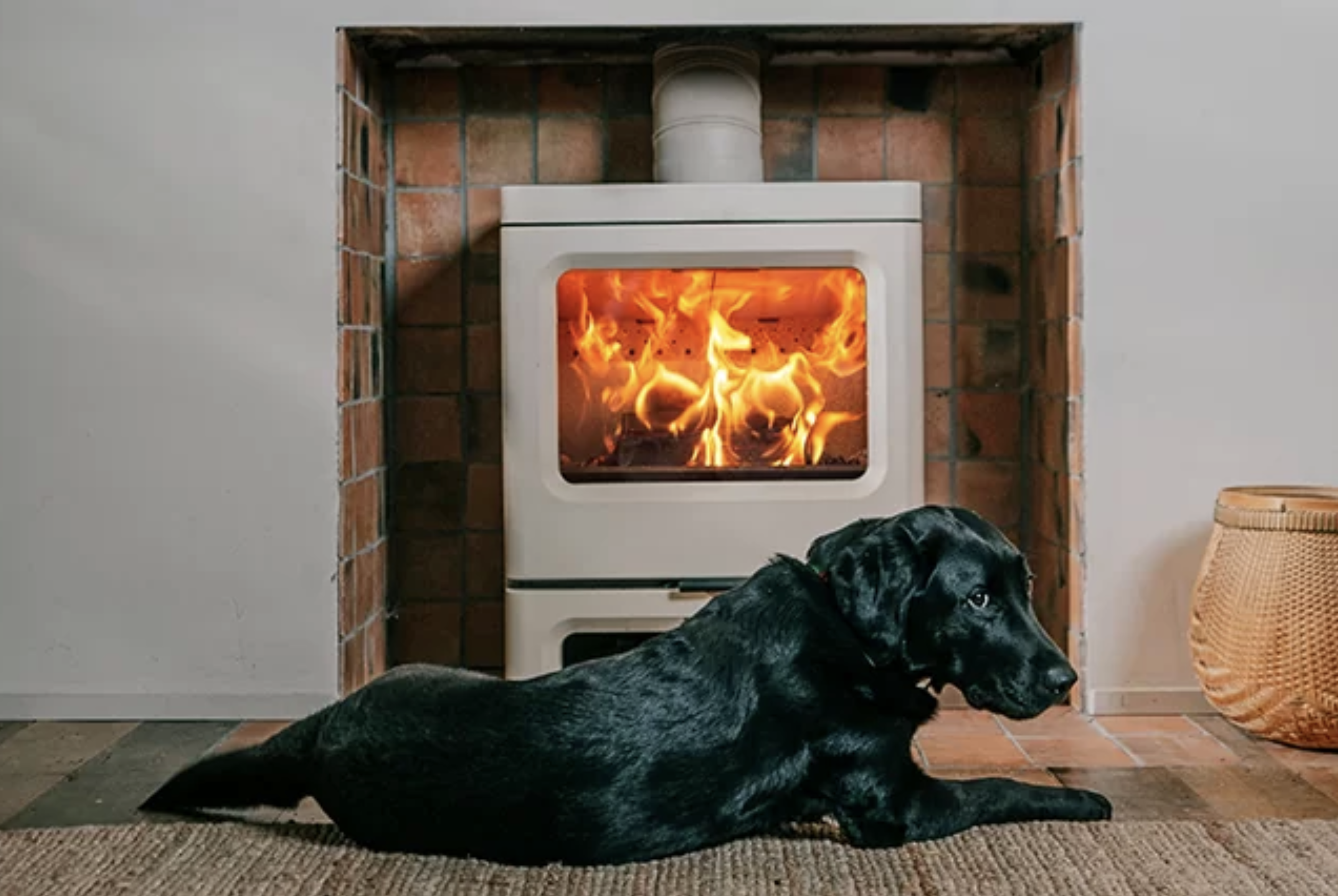

In the first quarter of the year three separate decisions—one from Westminster, one from Edinburgh and one from the UK’s advertising regulators—have had a huge impact on the wood-stove debate, by recognising the important role modern wood burners can play in a low-carbon future.
1. Future Homes Standard: Government says yes to stoves
Responding to a joint letter co-ordinated by the Stove Industry Association (SIA) and signed by more than 1,500 businesses and woodland owners, the Ministry of Housing, Communities & Local Government has confirmed:
“Under the standards proposed in the consultation, a wood-burning stove would be permitted as a secondary heating source in new homes.” Stove Industry Association | SIA
The department also acknowledges that smoke can be significantly reduced when the right appliances, fuels and practices are used. For self-builders and developers, that ends months of conjecture about an outright ban and restores genuine choice in low-carbon heating design. Meaning the unique benefits of wood-burning stoves, from energy security to improved wellbeing (and many more) will quite rightly continue to be available to all.
2. Advertising watchdog pulls up Brighton’s “Cosy Killer” campaign 
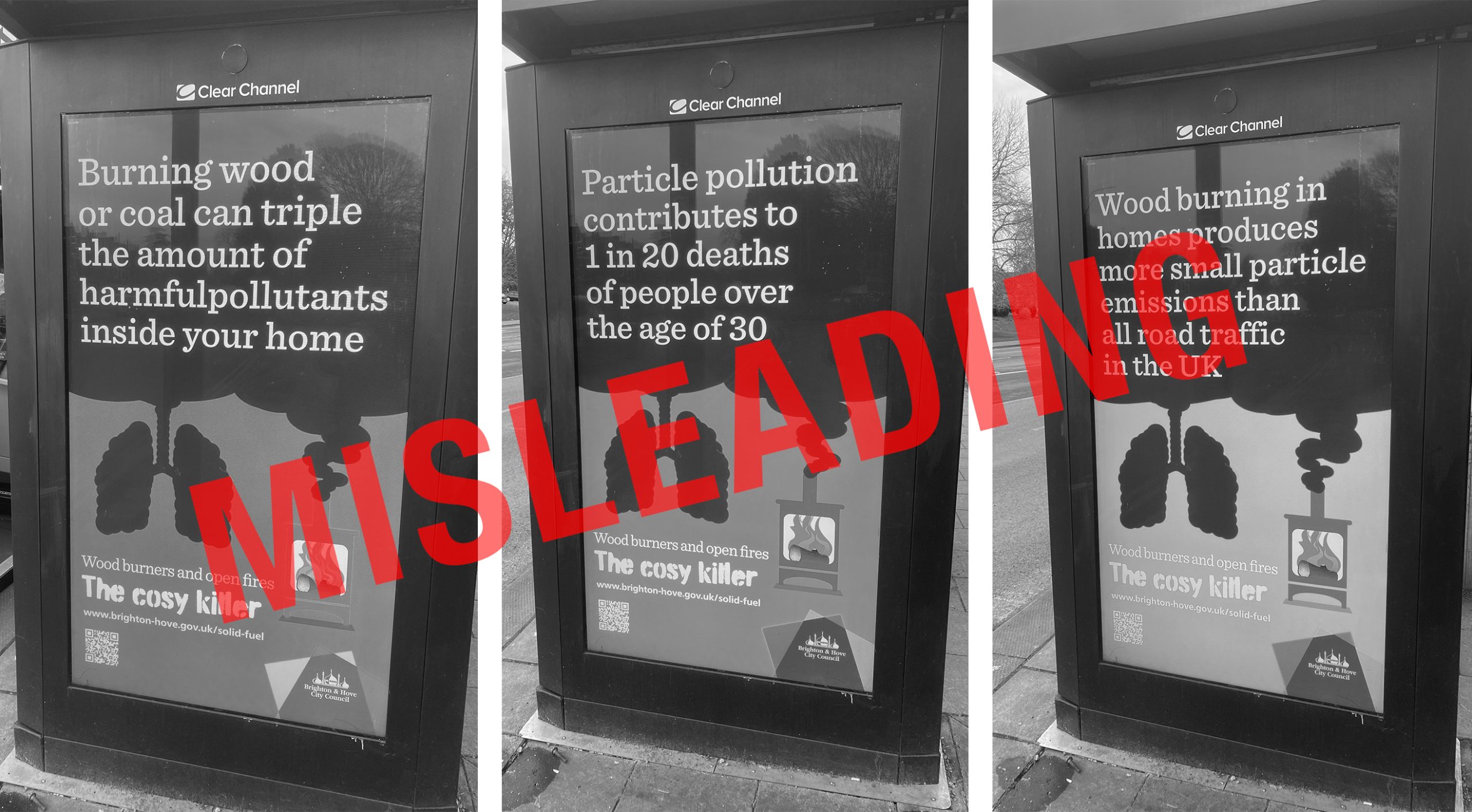
The Advertising Standards Authority has now responded to a complaint about Brighton & Hove City Council’s “Cosy Killer” posters, which linked particle pollution from stoves to “1 in 20 deaths”. In a response to local Brighton stoves businesses Heat Stores, Hove Wood Burners and The Purple Sweep the ASA states that the complaint “raises a valid point” and that the claim could not be substantiated as presented. Although the case was resolved informally (the ASA issued compliance advice rather than a formal ruling), the Council has been told how to bring any future messaging into line with advertising codes.
Another key campaign claim was ‘Wood burning in homes produces more small particle emissions than all road traffic in the UK’. However, following a DEFRA data update in February which disputes this, The Purple Sweep raised this with Brighton Council, who were forced to quietly withdraw the claim for the remainder of the campaign. Sadly, the council has offered the public no statement of clarification or correction.
In plain terms, the UK’s advertising regulator has agreed that scare statistics need solid evidence before they can be splashed across billboards—a common sense and reassuring result for both installers and consumers who rely on balanced, factual information.
3. Scotland’s ban scrapped after rural backlash
North of the border, Holyrood has formally amended the New Build Heat Standard to allow wood-burning stoves in new homes after January 2025, citing resilience concerns in rural and island communities. The Scottish Conservatives hailed the move as a “victory for common sense.” The Telegraph
With both UK and Scottish governments now aligned, the direction of travel is clear: modern stoves have a secure place in future-ready homes.
Latest emissions data: cleaner technology, cleaner air

Fresh statistics from Defra’s National Atmospheric Emissions Inventory (NAEI) show that overall, UK emissions of PM2.5 fell approximately 7% from 2022 to 2023, while PM10 dropped from 8%. Over the long term, PM2.5 is down 76 % (PM10 down 70 %) compared with 1990 levels—even though many more households now enjoy wood heat.
The report attributes the recent year-on-year decline in particular to the “introduction of cleaner residential wood-burning appliances” and reduced use of wet wood, noting that emissions from the small-combustion (domestic) sector have been falling even though wood fuel consumption has risen since 2018. In other words, the figures show that upgrading to a modern Ecodesign stove is improving national air-quality figures. GOV.UK
What about the critics?
Some campaigners remain opposed, with groups such as Mums for Lungs continuing to argue that wood should be phased out. However, these latest important rulings accept that Ecodesign technology plus best-practice burning bring emissions down to levels compatible with clean-air goals. That is why both Westminster and Holyrood opted for regulation and education over bans. We continue to be open to dialogue with Mums for Lungs and other critics and will continue to address concerns with technological innovation.
Why this matters for Charnwood owners
These three decisions all highlight the fact that modern, clearSkies-certified stoves are being recognised as part of the solution, not the problem. Here’s why this matters to you:
-Policy certainty – If you are planning a new build, a Charnwood appliance will integrate seamlessly with heat pumps and solar while meeting the Future Homes Standard.
-Demonstrable impact – The efficiency gains celebrated in Defra’s data are built into our latest models. The micro-processor-controlled Skye E700, for example, achieves 89% efficiency with automatic real-time airflow management.
-Balanced information – As regulators tighten standards, homeowners can begin to hope for a calmer, fact-driven discussion, which makes it easier to choose and use their stove with confidence.
SIA top tips for truly clean burning
-Choose an Ecodesign/clearSkies stove (Levels 3–5 are also Defra-exempt for Smoke Control Areas).
-Burn Ready to Burn logs (≤ 20 % moisture).
-Have your chimney swept and your stove serviced annually by an NVQ-qualified sweep.
-Follow the manufacturer’s operating instructions—small changes in loading and airflow make a big difference to emissions.
For more guidance, visit the SIA website or speak to your nearest SIA Retail Group showroom.
Common sense restored
Taken together, the Future Homes confirmation, the hard data on falling emissions, and a move toward evidence-led advertising mark a significant reset in the national conversation. The science, the regulators and the policy-makers are now aligned: when used responsibly, modern wood stoves deliver low-carbon heat, energy resilience and cleaner air.
Charnwood will continue to push the boundaries of combustion technology, but this month’s decisions show we are heading in the right direction and guided, at last, by some common sense. The rulings reinforce what the data already shows: modern Ecodesign stoves are a sensible part of the home-heating mix.